
Serving Mastery: Elite Routines for the Final Set
Master the high-pressure serve with professional pre-serve routines, breathing mechanics, and visualization techniques to slow down the fifth set.
By VolleyLab Coaching Staff
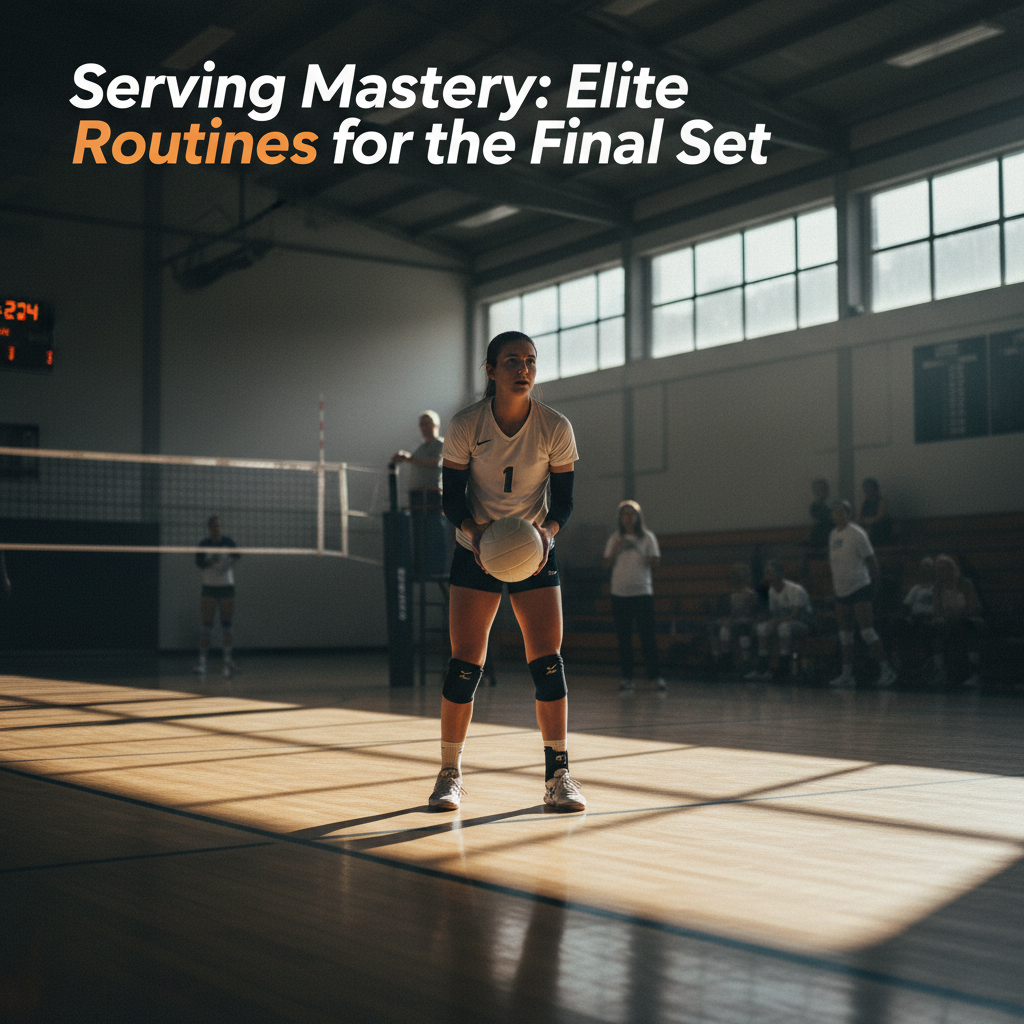
The Physiology of the Fifth Set Service
In the final set of a competitive volleyball match, the physiological state of an athlete changes significantly. Elevated cortisol levels and an increased heart rate can lead to 'heavy' hands and shortened muscular movements. For a server standing at the baseline at 13-14 in a deciding set, the goal is not to eliminate this adrenaline, but to channel it through a structured mechanical process. Precision in serving requires a fine motor control that is often the first thing to degrade under extreme stress. By implementing a standardized pre-serve sequence, players can bypass the panic response and engage the motor cortex for a consistent toss and contact.
The Anatomy of a Professional Pre-Serve Routine
A routine is not a superstition; it is a neurological bridge from a chaotic environment to a self-controlled execution. High-level players utilize a sequence that typically lasts between four and six seconds. This window is long enough to reset the heart rate but short enough to maintain the rhythm of the game. A routine should be identical whether the score is 0-0 or 24-24. If a player bounces the ball three times in practice, they must bounce it three times in the championships. Any deviation signifies to the brain that the situation is 'different' or 'dangerous,' which triggers the fight-or-flight response.
Standardizing the Mechanical Steps
- Find the Valve: Many professionals rotate the ball to find the valve or a specific logo to provide a consistent tactile feel.
- Set the Stance: Establish a lead foot and weight distribution. A 60/40 weight split toward the back foot allows for a powerful transfer forward.
- The Rhythmic Bounce: Use a specific number of bounces—usually two or three—to establish a physical tempo.
- Deep Diaphragmatic Breath: The final step before the toss to release upper body tension.
Respiration as a Performance Regulator
Breathing is the only autonomic function that can be consciously controlled to influence the nervous system. In high-pressure moments, athletes often take shallow chest breaths, which signals the brain to increase the heart rate. To counter this, competitive servers utilize 'tactical breathing.' This involves a slow inhale through the nose for four seconds, a brief hold, and a forceful exhale through the mouth just before the toss. This exhale is critical as it relaxes the trapezius and deltoid muscles, ensuring the arm swing remains fluid rather than rigid. If the shoulders are hiked toward the ears during the serve, the accuracy of the contact point will inevitably suffer.
Visualization for Temporal Distortion
Elite servers report that during their best performances, the game seems to slow down. This is not a superpower but a result of high-speed mental processing. Before the whistle blows, a player should engage in 'target internalizing.' Instead of looking at the whole court, the server should pick a specific patch of floor—six inches by six inches—or the shoulder of a specific passer. The server then visualizes the flight path of the ball, including the expected movement (seam, drop, or curve). This mental rehearsal primes the muscles for the exact force and angle required, reducing the 'processing lag' when the actual movement begins.
The Three-Point Visualization Drill
To practice this, players should stand at the service line during training and close their eyes for three seconds. During this time, they must visualize three specific things: the contact of their hand on the ball, the apex of the ball's trajectory over the net, and the ball hitting the target. Only after this mental 'video' is played do they open their eyes and execute the serve. Integrating this into 20 repetitions at the end of every practice session builds the mental stamina required for the fifth set.
Managing the Whistle to Toss Interval
The eight seconds allowed by the referee for a service attempt is an eternity in sport. Many junior players rush, tossing within one second of the whistle. This haste is a symptom of wanting to 'get it over with.' Competitive players utilize at least five of those eight seconds. This intentional delay forces the receiving team to stay in their ready position longer, often causing their focus to waver, while allowing the server to fully complete their respiratory reset. Controlling the tempo of the start of the rally is the first way to win the point.
Drills for Final Set Simulation
Training the serve in a vacuum is rarely effective for match conditions. To simulate the fatigue and mental load of a deciding game, coaches should implement high-stakes drills at the end of practice. The 'Pressure Ladder' is one such method. A player must make five consecutive serves to different zones. If they miss, they must perform a shuttle sprint and restart. The catch is that the last serve must be executed while teammates make noise to simulate a hostile crowd. This forces the athlete to rely solely on their internal routine to filter out external stimuli.
- Perform 10 heavy jumps to spike to elevate heart rate to 160+ BPM.
- Immediately move to the service line.
- Execute the full pre-serve routine: find valve, set feet, three bounces.
- Take one tactical breath and execute a serve to Zone 1.
- Repeat for all six zones without missing.
The Role of Positive Self-Talk
Internal dialogue in the fifth set often shifts to 'don't miss' or 'don't hit the net.' The brain struggles to process negative commands; it focuses on the object mentioned (the net). Professional athletes replace these with technical 'cue words.' A server might say 'high elbow' or 'flat palm' to themselves. These instructions provide a specific mechanical focus that leaves no room for outcome-based anxiety. By focusing on the process (the swing) rather than the result (the point), the server increases the likelihood of a successful, aggressive serve that can end the match.
Related VolleyLab resources
Keep going with these hand-picked reads and programs from the VolleyLab library:
Turn this article into a training plan
VolleyLab builds a weekly program based on your position, level, and goals — no guesswork.
Start free trial