
Optimizing the 4-Step Outside Hitter Approach for Power
Master the 4-step approach mechanics to increase vertical height and solve slow closing steps. Improve your volleyball rhythm and arm swing efficiency.
By VolleyLab Coaching Staff
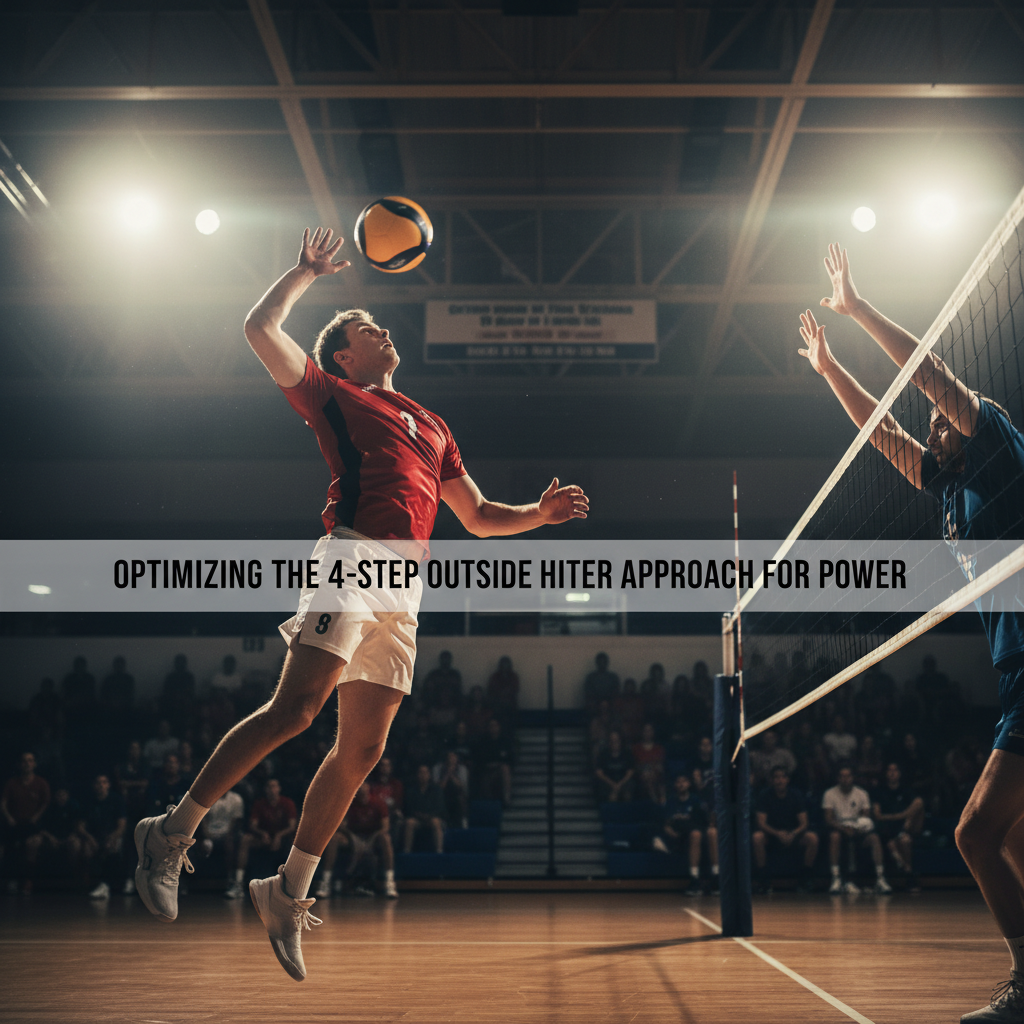
The Architecture of the 4-Step Approach
The standard 4-step approach serves as the foundational blueprint for elite outside hitters. Unlike the 3-step variation, which is often used in emergency or quick-transition scenarios, the 4-step method allows for superior weight transfer and momentum accumulation. For a right-handed hitter, the sequence begins with a small directional step on the right foot, followed by a larger timing step on the left, and concludes with the explosive right-left closing sequence. This structure provides the necessary time to read the set trajectory while maintaining a consistent linear path toward the ball.
The first step, often called the 'prep step', is frequently misunderstood as a power generator. In reality, its primary function is to establish the angle of approach. This small, controlled movement positions the body behind the ball, ensuring that the athlete remains in a 'vision-first' state. By the time the second step lands, the hitter must have calculated the peak of the set to adjust the subsequent tempo of their movement.
Rhythm and Momentum Grading
Rhythm in volleyball hitting is not a constant speed; it is an acceleration. The cadence is best described as 'slow-to-fast.' If the first two steps are as fast as the last two, the hitter will arrive at the contact point too early, resulting in a loss of vertical power and restricted vision of the block. The goal is to maximize horizontal velocity only during the final two steps, converting that forward energy into upward lift.
The Velocity Curve
- Step 1: Small, directional, 10% of total speed.
- Step 2: Medium, timing-oriented, 30% of total speed.
- Step 3: Large, aggressive, 70% of total speed.
- Step 4: The 'close' or 'block' step, 100% explosive stop and upward push.
Solving the Slow Last Two Steps
A common technical failure in club-level players is 'paddling' or taking small, stuttered steps at the end of the approach. When the third and fourth steps lack aggression, the hitter loses the 'penultimate' effect. The penultimate step—the second to last step—must be the longest and fastest of the four. This step lowers the center of mass, pre-loading the quadriceps and glutes for the vertical jump. If this step is short, the athlete jumps primarily from their knees, limiting their reach by 2 to 4 inches.
To fix a slow finish, coaches should focus on the 'sound' of the footwork. A high-quality close should sound like a rapid 'da-DUM.' The delay between the third step hitting the ground and the fourth step planting should be minimal. Athletes struggling with this often have a 'timing leak' where they wait too long to initiate after the setter releases the ball. To resolve this, hitters should practice starting their approach slightly later than they feel comfortable, forcing them to accelerate to catch the ball at its highest point.
Arm Swing Integration and Pendulum Mechanics
The arm swing is not merely for hitting the ball; it is a critical component of the jump itself. As the hitter moves into the large penultimate step, both arms should be driven back forcefully, parallel to the floor or higher. This backward extension acts as a counterbalance. As the final step plants, the arms must whip forward and upward simultaneously. This synchronized lift can contribute up to 15% of total vertical displacement through the transfer of momentum.
Once in the air, the hitting arm should transition into a 'bow and arrow' position. The non-hitting arm remains high to track the ball and provide core stability, while the hitting shoulder rotates back. Effective hitters avoid 'dropping the elbow,' a mistake that lowers the contact point and makes the player easier to block. The elbow should remain above the shoulder line throughout the entire loading phase of the swing.
Drills for Approach Efficiency
To refine these mechanics, players should engage in isolated footwork training before introducing the ball. High-repetition sets allow for muscle memory development without the distraction of a fluctuating set. The following progression is recommended for daily training sessions.
- Dry Footwork (3 sets of 10): Perform the 4-step approach without a ball, focusing exclusively on the 'slow-to-fast' rhythm and the deep arm drive.
- Box Penultimate Transitions (4 sets of 8): Step off a 12-inch box directly into the last two steps. The drop adds forced momentum that must be converted into a vertical jump.
- Accelerated Tosses (5 sets of 10): A coach tosses balls with a progressively faster tempo, forcing the hitter to increase their closing step speed to beat the ball to the spot.
- Targeted Speed Jumps (3 sets of 12): Focus on the sound of the 'da-DUM' rhythm, attempting to minimize the time the feet are in contact with the ground on the final two steps.
Correcting Lateral Drift
Another byproduct of poor 4-step footwork is drifting. Drifting occurs when the hitter continues their forward momentum through the air rather than converting it vertically. This often results in the hitter landing under the net or consistently hitting into the block. To correct this, the fourth step (the 'block' or 'stop' step) must be turned slightly inward, perpendicular to the path of the approach. This 'T-plant' serves as a brake, halting forward motion and forcing the energy upward.
The distance from the net is also vital. A competitive hitter should aim to plant their feet approximately 3 to 4 feet away from the net. This gap allows the hitter to keep the ball in front of their body, providing a clear view of the opposing team's defensive alignment. Contacting the ball while it is slightly in front of the hitting shoulder is the only way to maximize the 'torque' created by the core muscles during the final swing phase.
Related VolleyLab resources
Keep going with these hand-picked reads and programs from the VolleyLab library:
Turn this article into a training plan
VolleyLab builds a weekly program based on your position, level, and goals — no guesswork.
Start free trial