
Mastering the Jump Serve Toss: Stability and Precision
Unlock a consistent jump serve by mastering toss height, contact location, and a specific pressure-based drill to eliminate common foot-faulting errors.
By VolleyLab Coaching Staff
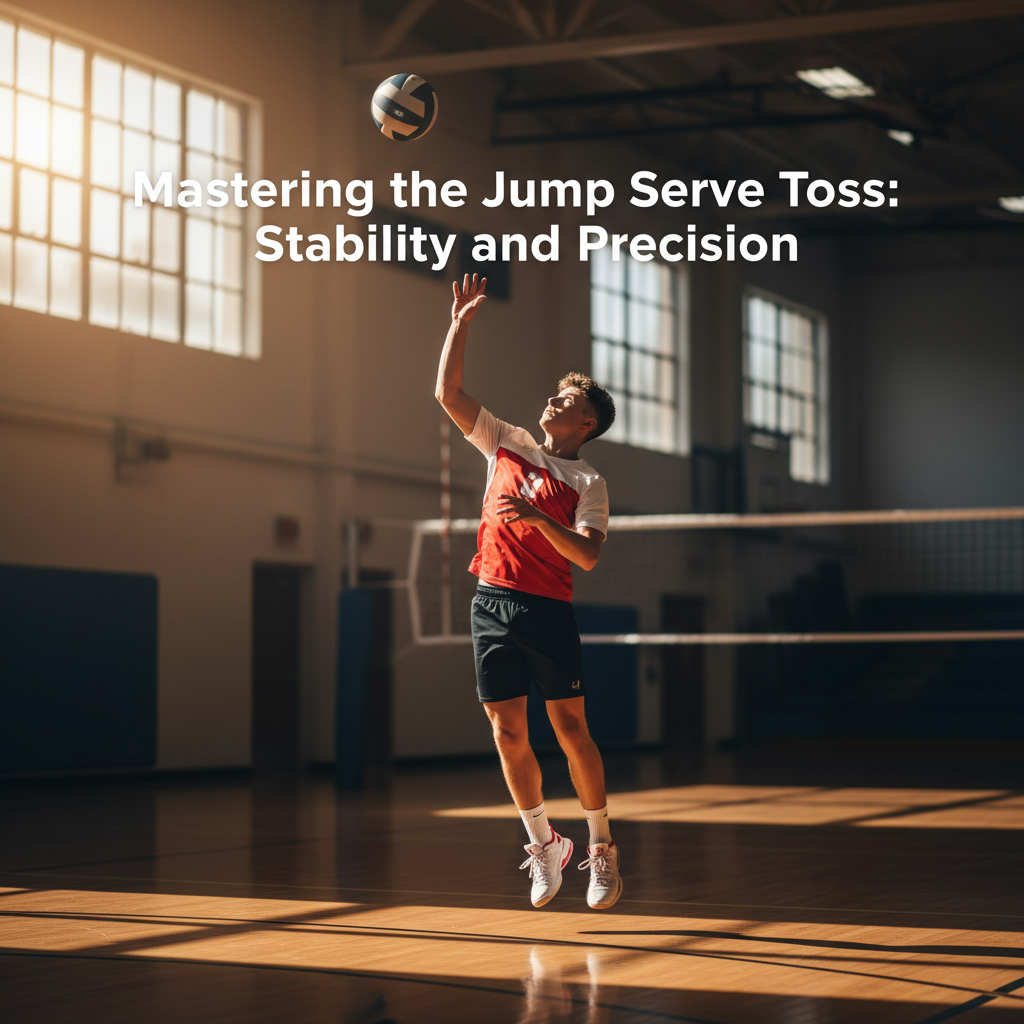
The Physics of the Modern Jump Serve
The jump serve is often misunderstood as an exercise in raw power. In reality, it is a calculation of temporal and spatial alignment. The margin for error on a high-velocity serve is measured in centimeters. If the ball is ten centimeters too deep, the swing results in a long ball; ten centimeters too low, and the ball finds the tape. The foundation of this entire sequence is not the jump or the swing, but the toss. A wandering toss forces the athlete to adjust their approach mid-flight, which destroys kinetic efficiency and leads to shoulder strain.
To achieve a professional-grade serve, the server must view the toss as the first half of the attack. It is not merely putting the ball in the air; it is setting a target for a pre-determined approach path. Effective servers prioritize a toss that allows for a three-step or four-step approach with maximum vertical displacement. By standardizing the height and depth of the release, the brain can automate the footwork, allowing the athlete to focus entirely on the contact point.
Determining Optimal Toss Height
Toss height is a personal variable, yet it remains governed by the laws of gravity. A higher toss allows more time for a powerful approach but increases the impact of wind and slight release errors. A lower toss is easier to control but requires a faster reaction time and often limits the server's peak height. For most competitive players, the ideal height is roughly 1.5 to 2 meters above the reach of the hitting hand at the peak of the jump.
Measuring Success with Seconds
Consistency can be measured through a stopwatch. A standard high-level jump serve typically features a hang time (from release to contact) of approximately 1.2 to 1.5 seconds. If a player finds their serve timing varies wildly, they should record their reps and timestamp the release and the hit. A variance of more than 0.2 seconds between reps indicates an unstable release mechanism that will fail under match pressure.
Contact Point and Depth Precision
The most common error in club-level jump serving is tossing the ball too close to the baseline. In a dynamic jump serve, the athlete should ideally contact the ball 0.5 to 1.0 meters inside the court while their feet remain behind the line during the takeoff. This forward momentum is what generates pace. If the ball is tossed directly above the baseline, the server is forced to jump straight up, losing the horizontal energy required for a heavy serve.
Correct contact occurs at the 1 o'clock position (for right-handers) relative to the head. The arm should be fully extended, with the shoulder high. A contact point that is too low results in a 'flat' trajectory that lacks the necessary clearance over the net. To test this, servers should aim for a contact height that is at least 3 meters above the floor, ensuring the ball has a downward angle once it clears the net.
The Three-Anchor Release Technique
To eliminate the wandering toss, servers should implement the three-anchor release. This technique focuses on three specific physical cues to ensure the ball travels the same path every time. By isolating these movements, the player reduces the number of variables the brain must process during the high-stress environment of a match.
- Consistent Stance: The lead foot must be aimed at the target, slightly angled to allow the hips to open.
- Weight Transfer: The toss must begin with a shift from the back foot to the front foot, using the core to lift the ball rather than just the arm.
- Soft Fingers: Avoid 'flipping' the wrist. The ball should have minimal spin upon release to ensure the flight path is not affected by aerodynamic drag.
The Pressure Fix: The Box-Target Drill
This drill is designed to fix a wandering toss by introducing spatial constraints and mental fatigue. Many players can toss accurately in an empty gym, but their technique breaks down when they are tired or when the game is on the line. The Box-Target Drill forces the server to maintain precision within a predefined physical limit.
Drill Setup and Execution
- Place a 1x1 meter square (using floor tape) approximately 1 meter inside the baseline in the server's preferred lane.
- The player performs 10 consecutive tosses without jumping, aiming for the ball to land squarely in the center of the tape box.
- Once 10 perfect tosses are achieved, the player adds the full approach and jump, but catches the ball at the peak without swinging.
- Add a visual distractor, such as a coach moving across the net, to simulate match chaos.
- Complete 3 sets of 15 reps. Any toss that lands outside the box resets the current set to zero.
The goal of this drill is to build muscle memory that resists the urge to chase a bad toss. If the toss logic is flawed, the athlete must learn to let the ball drop rather than attempting to save it with a sub-optimal swing. In a competitive match, the ability to reset after a poor toss is more valuable than the ability to hit a desperation serve into the net.
Integrating Velocity Training
Once the toss location is localized to the 1x1 meter box, the server can begin to integrate velocity training. Speed is a byproduct of a clean contact point and a fast arm swing. However, speed should never be chased at the expense of toss accuracy. A serve hit at 80 kilometers per hour that travels to a specific target is significantly more effective than one hit at 100 kilometers per hour that is unpredictable for the server themselves.
Athletes should use a radar gun or video analysis to track the correlation between their release height and their resulting serve speed. Often, a slightly lower, more forward toss results in a faster serve because it allows for a more aggressive 'chase' by the server, utilizing the entire body's mass in the strike. This integration marks the transition from a player who merely puts the ball in play to one who dictates the pace of the game from the service line.
Related VolleyLab resources
Keep going with these hand-picked reads and programs from the VolleyLab library:
Turn this article into a training plan
VolleyLab builds a weekly program based on your position, level, and goals — no guesswork.
Start free trial