
Mastering the Clutch Serve: Late Set Psychology and Routines
Learn professional pre-serve routines and visualization techniques to maintain focus and control during high-pressure final set moments in volleyball.
By VolleyLab Coaching Staff
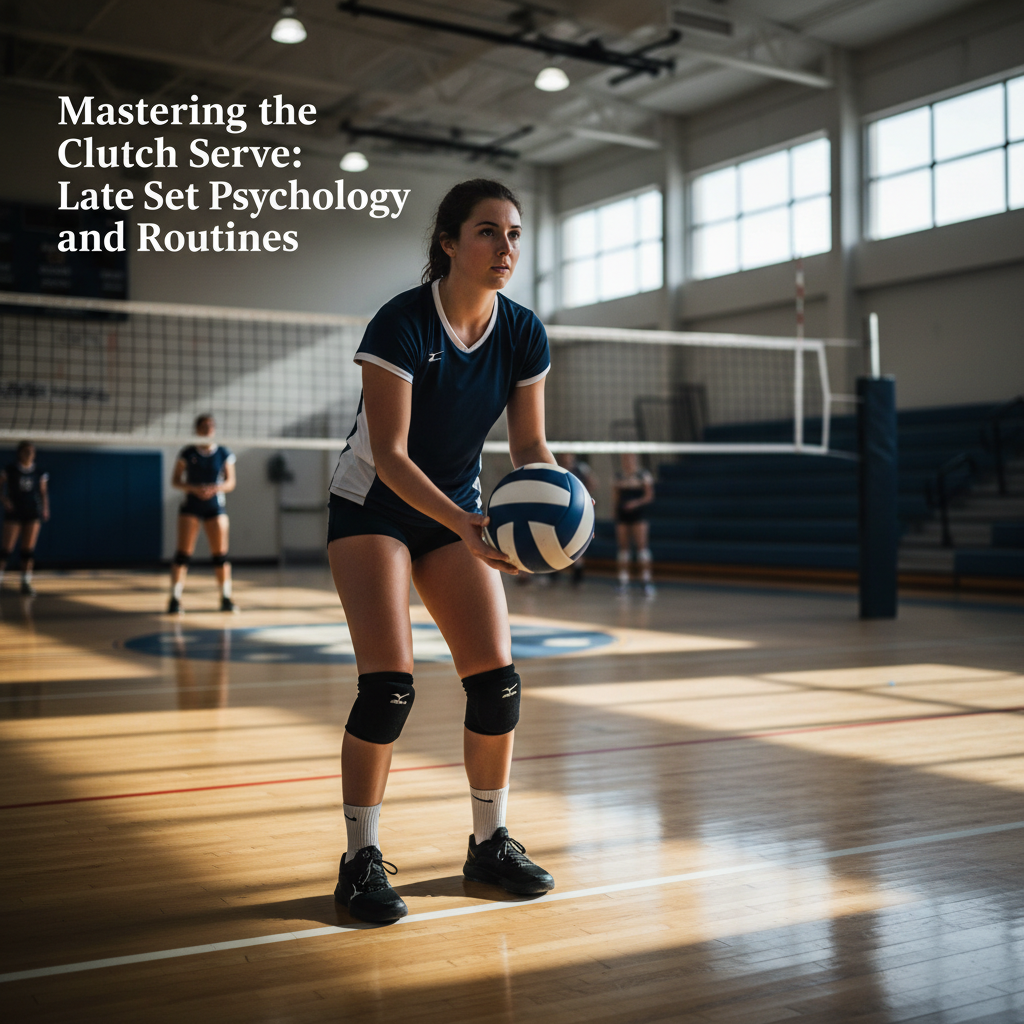
The Physiology of Final Set Pressure
In the fifth set of a competitive match, the sympathetic nervous system often takes over. Heart rates frequently climb 20 to 30 beats per minute above baseline even during brief breaks in action. For a server, this physiological shift manifests as shortened breath, increased muscle tension in the shoulder girdle, and a perceived acceleration of time. When the referee blows the whistle, that eight-second window can feel like two. To counteract this, elite players utilize specific neurological anchors to regain autonomy over their motor skills.
The goal of a high-pressure serve is not necessarily to increase power, but to maintain the integrity of the contact point. Stress narrows the focus, often causing athletes to rush their toss or truncate their follow-through. By understanding that the body is in a state of hyper-arousal, a player can implement protocols designed to stimulate the parasympathetic response, effectively slowing down the internal clock before the arm swing begins.
The Anatomy of a Pro-Level Pre-Serve Routine
A routine is not a superstition; it is a sequence of cues that tells the brain to move from a reactive state to a proactive one. Pro players rarely deviate from their sequence by even half a second. This consistency provides a sense of familiar territory in an unfamiliar or high-stakes environment. The sequence generally follows a three-stage progression: the physical reset, the visual scan, and the kinesthetic cue.
Stage One: The Physical Reset
Upon walking to the service line, the first movement should be the establishment of a stable base. Feet should be set at a 45-degree angle to the end line, providing a firm foundation for the weight transfer. Many athletes use a specific number of ball bounces—usually three—to synchronize their rhythm. These bounces serve as a metronome, grounding the athlete in the physical environment and dampening the noise of the crowd or the score.
Stage Two: The Sightline Scan
Before the toss, the eyes must perform a dual-target scan. First, identify the zone or the specific passer to be targeted. Second, look at the top of the net tape. Looking at the net tape for one second helps recalibrate depth perception, which can be distorted by fatigue. This visual lock-in transitions the brain from 'don't miss' to 'hit the target,' a subtle but vital shift in intent.
Utilizing Breath to Control Tempo
Breath is the most effective tool for regulating the central nervous system under duress. When oxygen levels fluctuate due to short, shallow breathing, fine motor control suffers. Competitive servers use the 'exhale on execution' method to ensure core stability. The sequence typically involves a deep diaphragmatic inhalation while the referee prepares to whistle, followed by a controlled release during the toss.
- Inhale for 4 seconds through the nose as you approach the line.
- Hold for 2 seconds to stabilize the rib cage and core.
- Slowly exhale through pursed lips as you bounce the ball.
- Release a sharp, short breath at the moment of hand-to-ball impact.
This breathing pattern forces the heart rate to plateau. If an athlete skips this, the adrenaline surge often leads to a 'heavy hand,' where the player swings significantly harder than necessary, causing the ball to sail long. Consistent breathing ensures that the swing speed remains identical to the speed practiced during thousands of repetitions in the training hall.
Visualization and Mental Subtraction
Visualization in the final set is not about dreaming of a win; it is about simulating the flight path of the ball. This is often called 'External Focus of Attention.' Research suggests that focusing on the trajectory of the ball leads to better performance than focusing on the mechanics of the arm swing. Pros use a technique called 'The Tracer,' where they mentally draw a neon line from their hand, over the net, to the deep corner or the seam between passers.
Mental subtraction is the second part of this process. It involves removing the context of the game. The server mentally deletes the score, the opponent's bench, and the stakes of the match, reducing the task to a simple geometric problem. The focus shifts entirely to the relationship between the palm and the leather. By the time the ball is tossed, the only thing that exists is the contact point.
Training Protocols for High-Pressure Serving
To perform in the 15th point of the fifth set, training must replicate the cardiovascular and psychological load of that moment. Standard block practice where a player hits 50 serves in a row is largely ineffective for late-game preparation because it lacks the 'one-and-done' nature of real competition. Instead, athletes should transition to random and competitive variables.
- The Heart Rate Drill: Perform 10 burpees or a full-court sprint, then immediately walk to the line and serve one ball to a target zone within 8 seconds.
- The Consequence Set: Serve a single ball. If it misses the target or hits the net, the player must reset and wait 60 seconds before trying again, simulating the time between points.
- The Pressure Ladder: In a group of three, each player must serve to a specific zone. If one person misses, the entire group restarts at zero until they reach 10 consecutive makes.
- The Targeted Fade: Serve 5 balls to Zone 1, then 5 to Zone 5, but each serve must be 5% slower or 5% faster than the previous one to develop touch.
These drills force the athlete to utilize their pre-serve routine under physical fatigue. The goal is to make the routine so reflexive that it remains intact even when the brain is screaming for the point to be over. Mastery of the routine leads to mastery of the moment.
Recovering from a Service Error
Mistakes are inevitable, even for elite specialists. The difference lies in the recovery. If a server misses a crucial ball in the final set, the priority is to prevent that error from affecting their defensive or offensive contributions in the following rallies. Professional players use a 'physical trigger' to dump the negative feedback. This might be adjusting their kneepads, wiping their shoes, or a specific clap. This movement signals to the brain that the previous event is closed and the current defensive cycle has begun.
For coaches, reinforcing the process over the outcome is essential during the final set. If a player executes their full pre-serve routine and hits their desired window but the ball catches the tape, it is a technical success despite the scoreboard result. By focusing on the controllable elements—the breath, the routine, and the visual target—players remove the fear of failure and replace it with the precision of a trained skill.
Related VolleyLab resources
Keep going with these hand-picked reads and programs from the VolleyLab library:
Turn this article into a training plan
VolleyLab builds a weekly program based on your position, level, and goals — no guesswork.
Start free trial