
Mastering the Block: Shoulder Angles and Swing Tells
Learn how elite middle blockers read hitter shoulder mechanics and arm swing cues to improve timing and closing speed in competitive volleyball.
By VolleyLab Coaching Staff
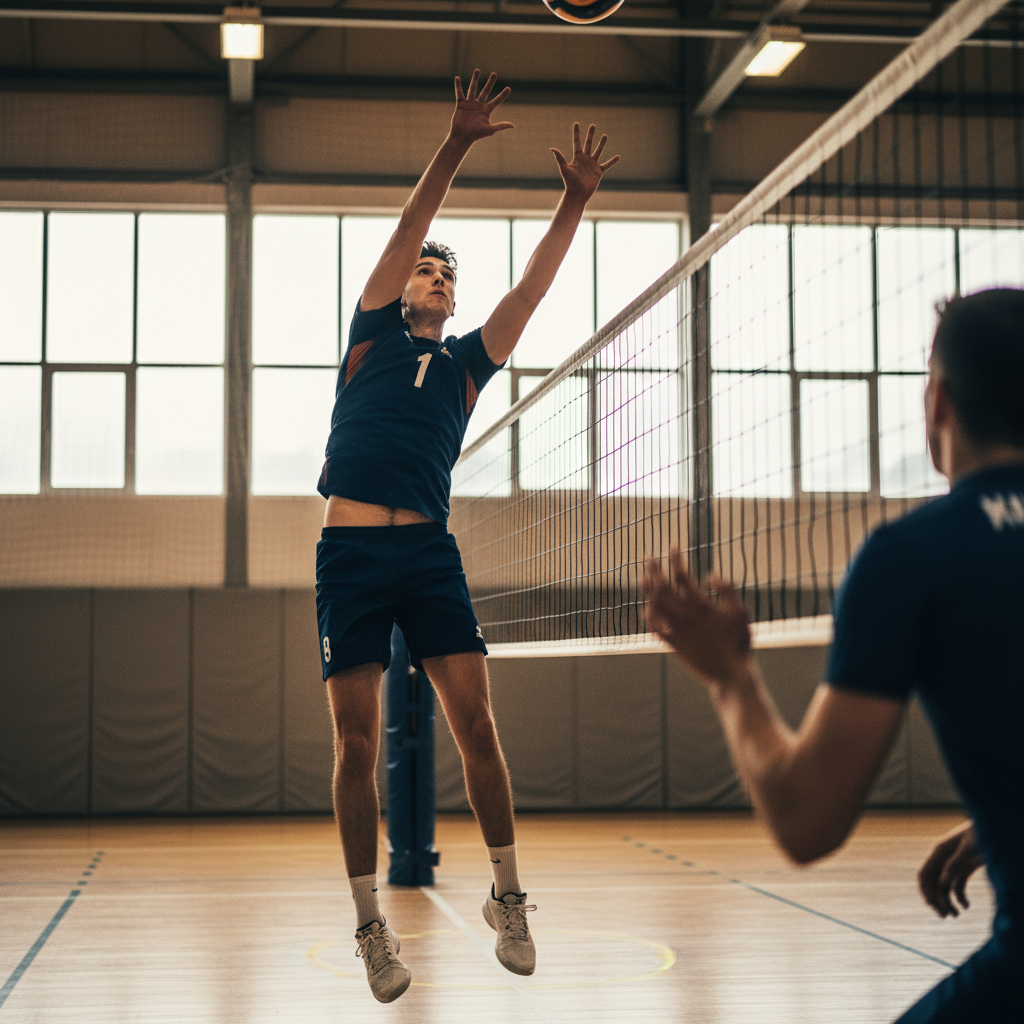
The margin for error at the net is measured in milliseconds. High-level blocking is not a reactive jumping contest; it is a predictive science based on visual cues. To move from a passive block to a dominant one, players must shift their focus from the ball to the attacker’s physical architecture. The trajectory of the set matters only until the hitter begins their approach. Once the attacker leaves the floor, the shoulder angle and arm swing mechanics become the primary data points for a successful stuffing action.
The Kinetic Chain of the Attacker
A hitter’s intention is revealed long before the palm makes contact with the leather. The eyes of the blocker should track the sequence of the approach, but real commitment begins at the plant. When an attacker plants for a jump, their hip orientation provides the first clue. However, the most reliable indicator of the final shot direction is the draw of the hitting arm. A high elbow draw generally indicates a deep corner shot or a high-hands wipe attempt, while a dropped elbow often signals a roll shot or a sharp cross-court cut.
Middle blockers must recognize the concept of 'shoulder squaring.' If a hitter squares their chest to the net, they are biomechanically limited to hitting within a 45-degree cone directly in front of them. If the hitting shoulder remains retracted late into the jump, the attacker is likely loading for a cross-body power shot. Recognizing this retraction allows the blocker to adjust their lateral hand position, reaching over the net into the expected line of fire rather than jumping straight up and down.
Shoulder Angle as a Directional Compass
The angle of the hitting shoulder relative to the net is the most honest signal in volleyball. While elite hitters can 'look' one way and hit another, they cannot violate the laws of physics. To generate power, the shoulder must rotate through the ball. By observing the tilt of the lateral deltoid, a blocker can determine the verticality of the swing. A shoulder that dips significantly during the penultimate step suggests a sharp angle hit, as the body tilts to create a steeper downward trajectory.
- Inside Shoulder Low: High probability of a sharp cross-court attack.
- Level Shoulders: Indicates a drive toward the deep six or the back corners.
- Shoulder Shrug: Often a sign of a mishandled set where the hitter will attempt to tip or wipe the block.
- Rapid Torso Rotation: Signals a hard-driven ball requiring maximum block penetration.
The Split-Second Decision Tree
The temporal window for a block decision is approximately 300 to 500 milliseconds. This window begins when the setter releases the ball and ends at the peak of the hitter's jump. The decision tree for a front-row defender follows a strict hierarchy: Location, Distance, and Angle. First, determine where the ball is going. Second, assess how far the ball is from the net. If the ball is tight (within 2 feet), the blocker must prioritize 'press and reach.' If the ball is off the net (4 feet or more), the blocker must delay their jump to catch the ball at the apex of its downward flight.
Step 1: The Setter Release
Identify the target. Is it a fast tempo (31 or 51) or a high ball to the pins? The blocker must move their feet to the 'danger zone' before the hitter even begins their final two steps of the approach. Feet must be set before the jump to ensure a stable platform.
Step 2: The Arm Swing Load
As the hitter’s arm enters the 'bow and arrow' position, the blocker identifies the elbow height. A low elbow is an invitation to 'reach' rather than 'penetrate.' A high elbow requires the blocker to get their hands as far over the net as possible to take away the deep court.
Specific Drills for Reading Cues
To improve these skills, players should engage in concentrated reading drills rather than standard 6-on-6 play. Real growth happens when the blockers are forced to verbalize what they see before they act. This creates a cognitive link between visual stimuli and motor response.
- The Freeze Call: A coach stands on a box and mimics different arm swing loads. The blockers must shout 'Cross' or 'Line' before the coach completes the swing. Perform 3 sets of 15 reps.
- The Shadow Block: Blockers work in pairs. One is the 'hitter' who approaches and swings (no ball). The blocker must mirror the shoulder angle of the 'hitter' and penetrate the net in the corresponding zone. 4 sets of 10 repetitions.
- Late Release Drills: Setters throw balls at varying distances from the net. Blockers must wait until the arm swing starts before jumping, training their eyes to stay off the ball and on the hitter's torso. 20 focused reps per player.
Optimizing Hand Penetration and Positioning
Reading the hitter is useless if the hands are not positioned correctly. Once the shoulder angle is identified, the blocker must 'eye sequence' from the ball to the hitter and back to the ball. The hands should be hard and shaped like the ball. If the read indicates a cross-court swing, the 'outside' hand (furthest from the setter) must be turned inward to funnel the ball back into the opponent's court.
Middle blockers should emphasize 'independent hands.' Often, a hitter will change their swing at the last moment. If the blocker's arms are rigid and moved as a single unit, they are easily outmaneuvered. By maintaining slight flexibility in the shoulders, a blocker can shift their hands 4 to 6 inches laterally mid-air based on the final flick of the hitter's wrist. This level of reactionary adjustment is what separates club-level players from collegiate prospects.
Conclusion: The Mental Discipline of Defense
Becoming a great blocker requires the discipline to stop ball-watching. The ball cannot change direction on its own; only the hitter can influence its path. By studying the shoulder rotation and arm swing tells of the opponent, a blocker gains back the time lost during the hitter's approach. Consistently applying these reading techniques will lead to higher block-to-touch ratios and a more intimidating presence at the net. Defense starts with the eyes, is processed by the brain, and is finished with the hands.
Related VolleyLab resources
Keep going with these hand-picked reads and programs from the VolleyLab library:
Turn this article into a training plan
VolleyLab builds a weekly program based on your position, level, and goals — no guesswork.
Start free trial