
Mastering the Block: Shoulder Angles and Hitter Reading
Learn the mechanics of reading hitters from the block. Identify shoulder patterns, arm swing tells, and decision trees for high-level defensive play.
By VolleyLab Coaching Staff
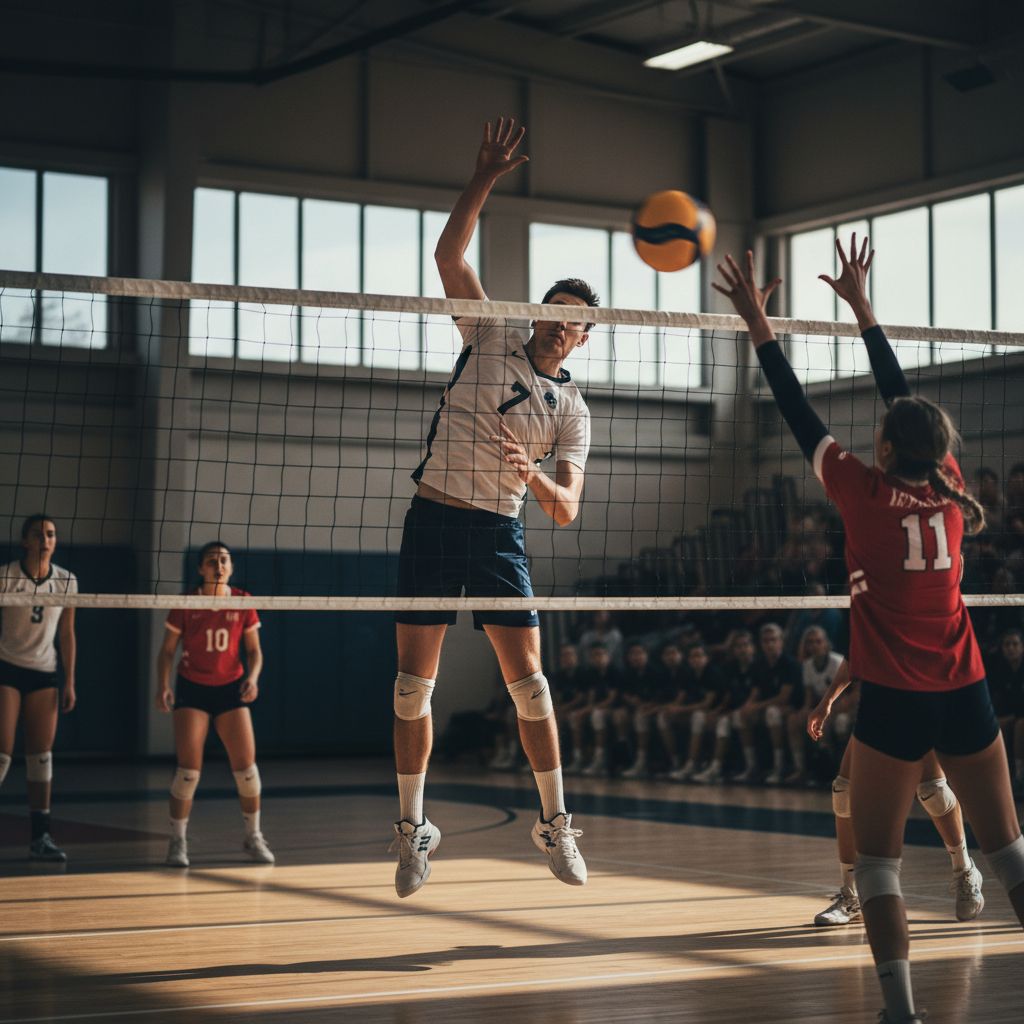
The transition from being a passive obstacle at the net to an active defensive force requires a shift in visual priorities. Many club-level players focus exclusively on the ball, neglecting the anatomical cues provided by the hitter. By the time the ball leaves the hand, it is too late to adjust. To reach elite efficiency, blockers must decode the attacker's mechanics—specifically the relationship between the approach path, shoulder rotation, and elbow height.
The Kinetic Chain of the Hitter
Visual tracking for a blocker begins long before the jump. The first data point is the hitter's approach angle. A hitter coming in at a steep 45-degree angle to the net has a natural mechanical advantage to hit cross-court. Forcing that hitter to swing line requires them to rotate their torso against their momentum, which often results in a slower ball or a less accurate shot. Conversely, a hitter approaching perpendicular to the net has more options, making the reading of the shoulder even more critical.
The second data point is the loading phase of the arm swing. As the hitter jumps, their non-dominant hand reaches up while the hitting shoulder drops and pulls back. Watch the depth of this shoulder pull. A deep, low shoulder pull typically indicates a full-power swing aimed at the deep corners. A shallow pull, or a shoulder that stays level with the chin, suggests a roll shot, a tip, or a controlled tool off the block's hands.
Decoding Shoulder Angle and Torso Tilt
Once in the air, the blocker has roughly 250 to 400 milliseconds to finalize their hand positioning. The most reliable indicator of contact direction is the angle of the hitting shoulder relative to the net. If the hitting shoulder remains 'open' or facing the setter, the hitter is likely going to contact the ball late, pushing it toward the line. If the shoulder 'closes' or rotates squared to the net during the swing, the hitter is generating torque to pull the ball toward the cross-court angle.
- Open Shoulder: High probability of a line shot or a wipe off the outside hand.
- Internal Rotation: Indicates a hard cross-body swing toward the middle of the court.
- High Elbow: Suggests a deep-corner swing or a push over the top of the block.
- Dropped Elbow: A primary indicator of a change in speed, often a tip or a low-power roll.
The Split-Second Decision Tree
Blocking is not just about jumping high; it is about decision-making under pressure. A blocker should follow a mental flowchart: Set identification, hitter approach, shoulder load, and final hand orientation. If the hitter's hand stays above their head with a fast wrist snap, the blocker must penetrate deep into the opponent's space. If the hitter's chest collapses forward, they are likely attempting a 'down-ball' into the middle of the court.
Refining Hand Orientation and Penetration
The final stage of reading happens when the hitter's hand enters the peripheral vision of the blocker. At this stage, the blocker should no longer be looking at the ball but at the hitter's palm. The orientation of the palm dictates the final 'press.' If the palm is turned outward toward the sideline, the blocker must strengthen their 'outside' hand to prevent an easy tool. If the palm is facing downward, the focus should be on maximum penetration over the net to cut off the angle at the source.
Elite blockers use a technique called 'independent hands.' Instead of moving both arms as a single unit, they track the hitter’s arm swing and may shift one hand farther toward the line while the other remains to take away the cross. This is only possible if the blocker reads the torso rotation early enough to maintain balance in the air.
Drills for Developing Defensive Vision
To improve these skills, training must move beyond basic footwork drills. Reading requires a live environment where the variable is the hitter's intent. Coaches should implement 'Read and React' sequences that force the blocker to verbalize the direction of the hit before the ball is actually struck.
- The Eyes-Up Drill: 3 sets of 10 reps. The coach stands on a box and initiates different shoulder tilts. The blocker must shout 'Line' or 'Cross' mid-air and move their hands accordingly.
- The Controlled Hitter Sequence: 20 repetitions. A hitter approaches with a deliberate shoulder lean. The blocker must ignore the ball and focus only on the shoulder, attempting to touch the ball based on the body's tell.
- Blind Set Blocking: The blocker starts with their back to the setter, rotates at the sound of the contact, and must immediate find the hitter's approach line to establish a base position.
Quantifying Success in Front-Row Play
Defensive success isn't always measured in terminal blocks. A blocker who successfully reads the shoulder and 'touches' the ball changes the game by slowing it down for the back-row defenders. In a standard 25-point set, a disciplined blocker might only get 2 or 3 clean blocks, but they may create 8 to 10 'controlled touches' simply by being in the right lane. Consistency in reading the arm swing reduces the 'seams' in the block, making it significantly harder for attackers to find the floor.
Closing the Gap on Hitter Deception
Modern attackers are taught to use their eyes to manipulate blockers, but the physics of the human body are harder to fake. While a hitter might look at the line, their hips and shoulders must eventually align with the intended direction of the swing to generate power. By prioritizing the larger muscle groups of the hitter—the hips and torso—over the deceptive movement of the eyes or the head, a blocker remains grounded in the mechanical reality of the play.
The mastery of the net is a game of inches and milliseconds. By moving focus from the ball to the attacker's bio-mechanics, blockers can anticipate rather than react, turning the net into a formidable barrier that dictates the flow of the entire rally.
Related VolleyLab resources
Keep going with these hand-picked reads and programs from the VolleyLab library:
Turn this article into a training plan
VolleyLab builds a weekly program based on your position, level, and goals — no guesswork.
Start free trial