
Mastering Middle Blocker Footwork and Defensive Reading
Improve your blocking efficiency by mastering shuffle and crossover steps, closing the seam, and reading setter hand positioning for faster reaction times.
By VolleyLab Coaching Staff
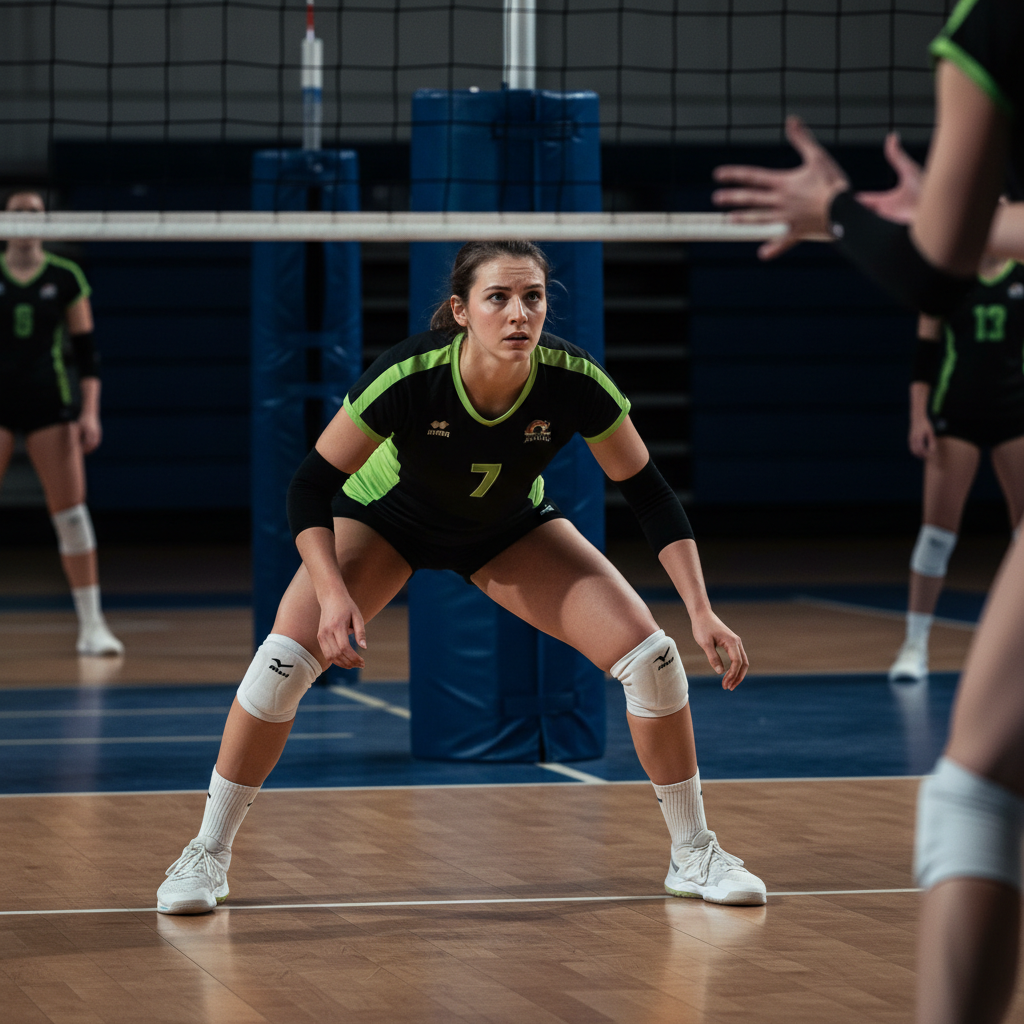
The middle blocker is the most physically demanding position on the volleyball court, requiring a combination of explosive lateral speed and calculated anticipation. To dominate the net, a player must transition from a neutral stance to a focused defensive position within a window of approximately 0.5 to 1.2 seconds. This speed is not achieved through raw athleticism alone but through the optimization of the two primary movement patterns: the shuffle and the crossover step.
The Mechanics of the Shuffle Step
The shuffle step is categorized as a short-range locomotion technique used for adjustments under three feet. It allows the blocker to maintain a square relationship with the net, keeping the hips and shoulders parallel to the opponent. This is vital when defending quick attacks or 'one' balls where the attacker is directly in front of the blocker. The power for this movement comes from the lead foot reaching and the trail foot pushing, ensuring the base of support remains wide and stable.
While the shuffle provides the highest level of balance, its limitation is speed over distance. A common technical error is 'clicking' the heels together, which creates a momentary lapse in stable ground contact. Effective shuffle technique requires maintaining a consistent gap between the feet, ensuring the center of gravity stays low. This positioning allows for a vertical jump at any micro-second during the lateral slide.
Executing the Explosive Crossover
When the ball is set to the pins—the outside or opposite hitter—the distance is too great for a shuffle. Here, the crossover step is the primary tool. It consists of three distinct phases: the directional step (lead foot), the crossover (the trailing leg swinging across), and the plant-and-turn (squaring back to the net). A well-executed crossover can cover ten feet in just two steps, allowing the middle to close the gap before the attacker makes contact.
The efficiency of the crossover is determined by the angle of the hips. During the middle phase, the hips must partially open toward the sideline to maximize stride length. However, the final landing must involve a hard 'penetration' step where the blocker plants their feet to redirect horizontal momentum into vertical lift. Failure to square the shoulders at the end of the crossover results in 'drifting,' where the blocker flies into the hitter’s lane or into the net, creating a dangerous situation and a poor block touch.
Closing the Block with Purpose
Closing the block refers to the synchronization between the middle and the wing blocker to eliminate the 'seam' or gap. A seam is an attacker’s greatest advantage, as it confuses the back-row defenders and creates a clear path for the ball to hit the floor. The middle blocker is responsible for 'closing' to the outside blocker’s set position. In a standard defensive system, the pins set the line, and the middle fills the interior space.
- Primary objective: Get hands across the net, not just above it.
- The 'press' should involve the arms reaching over the tape at a 45-degree angle.
- Visual focus should shift from the setter to the ball, and finally to the hitter's hitting shoulder.
- Seal the net by ensuring the elbows are locked and the palms are facing the center of the opponent's court.
Reading the Setter Hand Positioning
Anticipation is the difference between a late block and a dominant stuffed ball. This begins with reading the setter. Competitive players do not watch the ball after it leaves the passer's hands; they watch the setter's body language. Subtle cues in the hands and spine indicate where the ball will go. For example, if a setter’s back arches slightly before contact, there is an 80% higher probability of a back-set to the opposite hitter.
Visual Cues for the Middle
If the setter’s contact point is high and in front of their forehead, the ball is likely staying in front for a quick or an outside set. If the elbows flare out wide, the setter may be struggling with a ball out of system, making a long set to the pin unlikely. By narrowing the focus to the hands, the middle blocker can 'lean' into the predicted direction, shaving precious milliseconds off their reaction time.
Drills for Developing Lateral Fluidity
Movement patterns must be ingrained through high-repetition training. The following drills focus on the transition from reading to moving and finally jumping. These should be performed at the end of a warm-up or during a dedicated technical block session.
- The Box Mirror Drill: Two blockers face each other on opposite sides of the net. The 'lead' blocker shuffles and crossovers randomly; the 'follower' must mirror the movement instantly. Perform 3 sets of 45 seconds.
- Reaction Reads: A coach stands on a platform and presents ball positions (high, low, back-set) with their hands. The blocker must execute the correct footwork towards the designated wing. 20 repetitions per side.
- Seam Closure Sprints: Starting from center, the middle executes a crossover to the pin, jumps to close the block, then immediately shuffles back to center to defend a quick attack. 5 sets of 4 repetitions.
Strategic Implementation in Game Play
Consistency in footwork leads to defensive reliability. In high-pressure situations, players often revert to 'running' at the net rather than using structured steps. Senior players must resist this urge to maintain their verticality. By using the shuffle for the 3-foot range and the crossover for the 10-foot range, a middle blocker remains an intimidating presence throughout the entire 30-foot width of the net.
Ultimately, the goal is to be 'early and stable' rather than 'fast and floating.' A block that is set and stationary is significantly more effective than one moving laterally during the hitter's contact. Coaches should emphasize the landing as much as the jump, as a quick recovery allows the middle to transition for an offensive attack of their own, completing the cycle of the game.
Related VolleyLab resources
Keep going with these hand-picked reads and programs from the VolleyLab library:
Turn this article into a training plan
VolleyLab builds a weekly program based on your position, level, and goals — no guesswork.
Start free trial