
Mastering Kinetic Linkage: Increase Jump Serve Velocity
Unlock higher serve speeds through biomechanical efficiency, explosive medicine ball training, and a structured drill progression for competitive players.
By VolleyLab Coaching Staff
The Biomechanics of Elite Serve Velocity
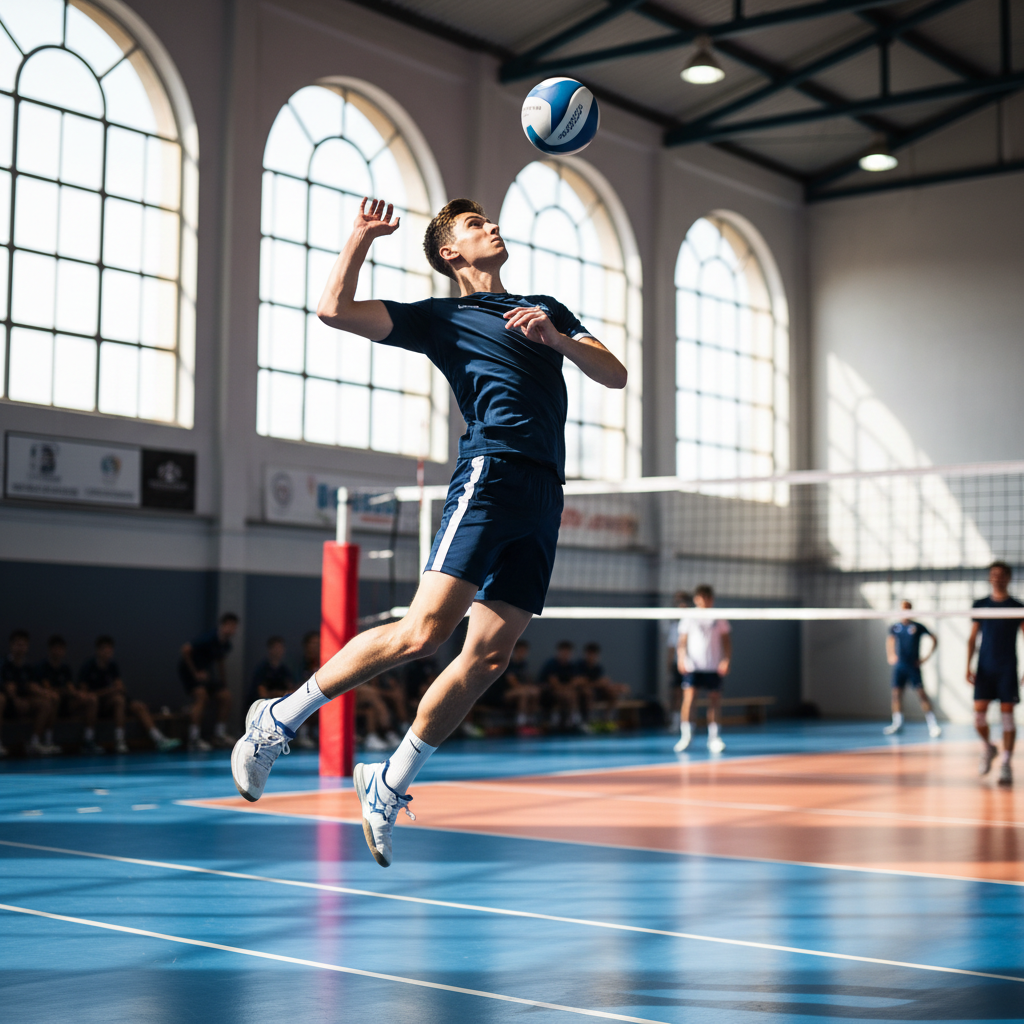
Adding miles per hour to a jump serve is often misunderstood as a simple requirement for more arm strength. In reality, elite serve velocity is a product of efficient energy transfer through the kinetic chain, starting from the floor and ending at the fingertips. The process begins with the approach, where horizontal momentum is converted into vertical lift. This transition requires a rigid penultimate step and a quick block foot placement to ensure that the force generated by the legs travels upward through the core.
The most critical phase for speed generation is the 'bow and arrow' posture, or the thoracic extension phase. As the athlete elevates, the hitting shoulder should be pulled back while the non-hitting arm reaches high toward the ball. This creates a diagonal stretch across the torso, loading the oblique muscles and the pectorals. When this tension is released, the body snaps forward, rotating the shoulder at high angular velocities. Without this trunk rotation, the arm is forced to do all the work, which limits potential speed and increases the risk of rotator cuff irritation.
Medicine Ball Protocols for Explosive Power
To increase the rate of force development in the serving motion, players must utilize weighted implements that mimic the specific planes of movement used on the court. Heavy lifting builds the baseline, but medicine ball work bridge the gap between pure strength and sport-specific speed. The focus here is not on the weight of the ball, but on the acceleration of the throw. A ball between 2kg and 4kg is ideal for most club-level athletes.
- Overhead Slam to Long Throw: Linear explosive power focusing on the late-stage abdominal crunch.
- Half-Kneeling Rotational Tosses: Isolates the obliques and teaches the athlete to drive power from the hips through the thoracic spine.
- Step-In Overhead Passes: Mimics the footwork of the approach while forcing the upper body to stabilize and launch from a moving base.
- Shot-Put Style Rotational Throws: Focuses on the hand-behind-the-ball orientation and the follow-through of the hitting shoulder.
Perform these exercises in two sessions per week during the off-season or early pre-season. A standard set includes 3 to 5 sets of 6 maximal effort repetitions. Quality and explosiveness are paramount; if the velocity of the throw drops significantly, the set should end. The goal is to train the nervous system to fire motor units rapidly, not to build cardiovascular endurance.
Sample Power Training Cycle
Over a six-week period, the medicine ball weight should remain constant while the intent increases. In weeks one through three, focus on the coordination of the throw. In weeks four through six, emphasize the split-second transition from the backswing to the release. Measured speed testing using a radar gun or video analysis can help track these incremental gains in torso rotation speed.
The Three-Stage Drill Sequence for Match Transfer
A common mistake in training is jumping straight into full-speed repetitions without calibrating the contact point. Friction between seasonal strength gains and technical execution often leads to missed serves. To fix this, athletes must follow a graduated sequence that isolates specific variables before combining them in a high-pressure environment.
- The High Contact Isolate: Standing 10 feet from the net, the athlete tosses the ball and focuses solely on hitting the highest point possible with a loose, fast arm. The target is the deep corner of the opposite court.
- The 15-Foot Approach Drill: Using only a two-step approach, the server works on the timing of the toss and the explosive 'snap' of the core. The shortened approach forces better synchronization between the toss height and the jump.
- The Baseline Pressure Cycle: Perform 10 serves at 90 percent effort. After every two serves, the athlete must complete a short burst of footwork or a defensive roll to simulate the fatigue felt during a long rally.
During the Baseline Pressure Cycle, the focus should be on the 'heavy' contact sound. A loud, sharp pop signifies a clean transfer of energy and a centered contact on the ball. If the sound is muffled or the ball has excessive side-spin (unless intentional), the hand is likely sliding off the side, indicating a breakdown in the kinetic chain or a late arrival to the ball.
Optimizing the Toss for Maximum Leverage
The toss is the most variable element of the jump serve. For maximum velocity, the ball must be thrown consistently 2 to 3 feet inside the court and 8 to 12 feet high, depending on the athlete's vertical reach. A toss that is too far behind the head forces the server to reach backward, breaking the thoracic arch and negating the power from the legs. Conversely, a toss too far forward results in a 'downward' hit that clips the net.
Competitive players should track their 'toss-to-contact' ratio. By recording practice sessions in slow motion, an athlete can identify if they are waiting for the ball to drop too low. Impacting the ball at the apex of the jump is non-negotiable for maintaining a high-trajectory serve that clears the net with enough speed to dive before the baseline. A higher contact point allows for a flatter, more aggressive flight path.
Structural Integrity and Shoulder Health
Increased velocity places immense strain on the posterior chain and the deceleration muscles of the shoulder. As an athlete adds 5 or 10 mph to their serve, the force required to slow the arm down after contact increases exponentially. Neglecting the eccentric strength of the rotator cuff and the stability of the scapula is a recipe for injury.
Incorporate 'Face Pulls' and 'Y-T-W' raises into every warm-up routine. These exercises activate the stabilizers that keep the humeral head centered in the socket during aggressive swings. Additionally, stretching the hip flexors is vital; tight hips limit the ability to arch the back during the loading phase, which indirectly increases the load on the lower back and shoulder. Power is a full-body investment, and the health of the joints determines the longevity of a high-speed server.
Final Integration into Competitive Play
In a match, the psychological pressure can lead to a 'tight' arm, which ironically slows down the serve. The final step in adding mph is developing a consistent pre-serve routine—such as a specific number of ball bounces or a deep breath—that triggers the nervous system to relax. Relaxed muscles move faster than tense ones. By combining this mental readiness with the biomechanical and explosive training outlined above, players can transform their serve into a genuine offensive weapon that dictates the pace of the game.
Related VolleyLab resources
Keep going with these hand-picked reads and programs from the VolleyLab library:
Turn this article into a training plan
VolleyLab builds a weekly program based on your position, level, and goals — no guesswork.
Start free trial