
Increase Jump Serve Velocity: Mechanics and Med-Ball Training
Master the technical mechanics and explosive power drills needed to add significant mph to your jump serve with a professional training progression.
By VolleyLab Coaching Staff
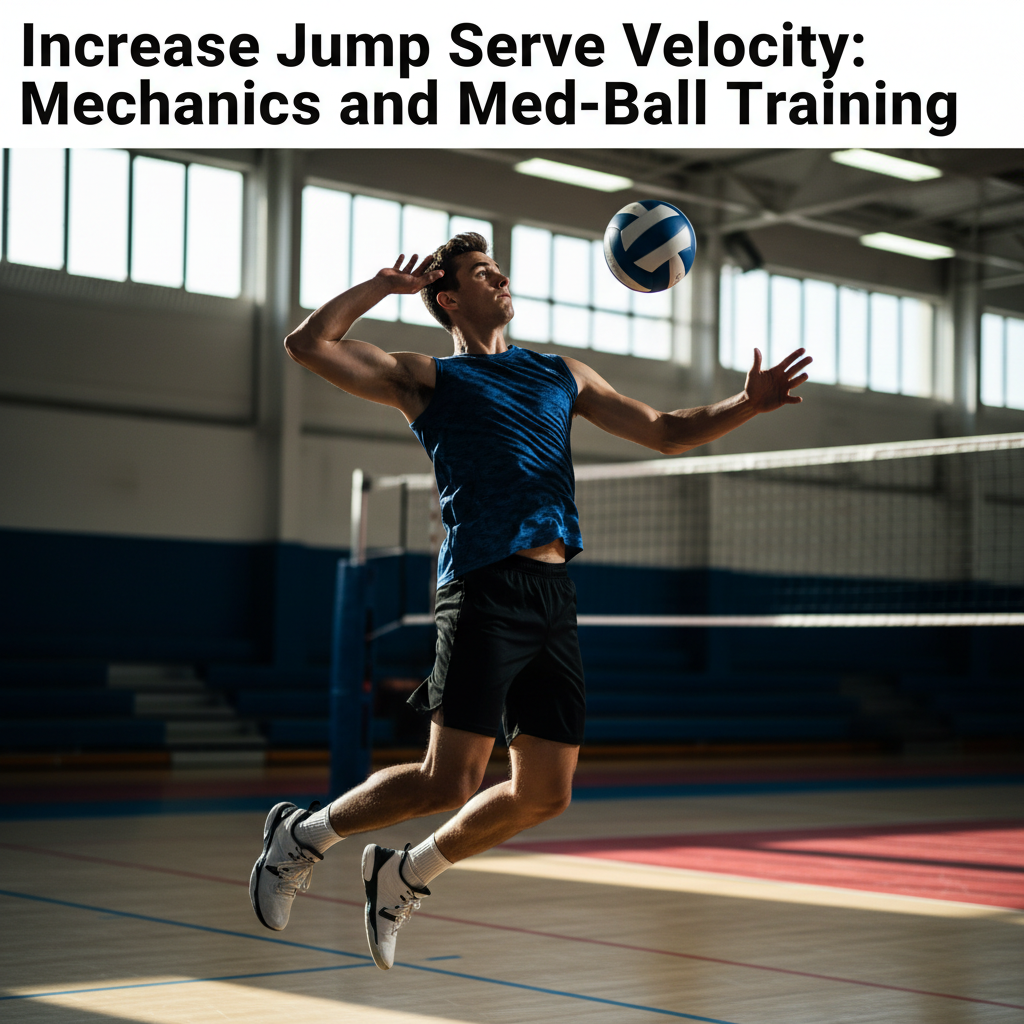
The jump serve is the ultimate offensive weapon in modern volleyball, but many athletes plateau because they rely solely on shoulder strength rather than kinetic linking. Increasing velocity requires a transition from arm-dominant movements to full-body explosive patterns. This guide outlines the biomechanical adjustments and specific weighted resistance protocols necessary to push serve speeds past the 55-65 mph threshold common in competitive club play.
The Biomechanics of Velocity
Velocity is a product of linear momentum converted into rotational torque. Many players lose speed during the transition from the approach to the jump. To maximize velocity, the penultimate step must be aggressive and long, allowing the center of mass to drop slightly before rebounding upward. This creates a stretch-shortening cycle in the core and hips that serves as the engine for the swing.
The hitting arm should remain relaxed until the moment of acceleration. A common mistake is ‘tensing’ the bicep during the draw. Instead, focus on a high-elbow draw where the hand stays outside the elbow path. This maximized shoulder external rotation creates a longer path for the hand to travel, allowing for greater acceleration before contact. The torso should rotate approximately 30 to 45 degrees away from the net during the peak of the jump, creating a coil that unleashes upon contact.
The Med-Ball Power Protocol
Strength in the weight room does not always equate to speed on the court unless it is trained through high-velocity movements. Medicine ball training bridges this gap by mimicking the specific planes of motion used in a jump serve. Use a 2kg to 4kg ball; exceeding this weight often slows the movement down too much to benefit serve speed.
- Rotational Wall Slams: Stand perpendicular to a wall and throw the ball horizontally using a full torso rotation. Perform 3 sets of 8 reps per side.
- Overhead Power Throws: Mimic the serve finish by throwing the ball downward at a 45-degree angle focusing on abdominal crunch. Perform 4 sets of 6 reps.
- The Step-In Slam: Take a two-step approach into an overhead slam to practice transferring forward momentum into vertical and downward force. Perform 3 sets of 10 reps.
Consistency in these movements builds the fast-twitch fiber recruitment necessary for an elite arm swing. These sessions should be performed twice weekly with at least 48 hours of recovery to ensure maximum explosive output. Focus on the intent of the throw rather than just completing the repetitions.
Optimizing the Toss and Ritual
The toss dictates the success of the serve. If the toss is inconsistent, the body must compensate mid-air, which kills momentum and reduces power. For maximum velocity, the toss must be approximately 3 to 5 feet inside the court. This forces the player to chase the ball forward, ensuring that their entire body weight is behind the strike.
Targeting the Contact Point
Contact should be made at the highest possible point, roughly at 'one o'clock' relative to the hitting shoulder. Striking the ball too low causes a loss of leverage, while striking it too far behind the head results in a float effect or high-error rate. The hand must be firm, with a wide palm to maximize surface area contact, allowing for the transfer of energy from the palm to the center of the ball.
The 3-Phase Drill Sequence for Match Transfer
Training velocity in a vacuum is rarely effective. Players must learn to maintain high speeds under the pressure of match-like conditions. Use the following sequence during team practices to solidify the mechanical changes.
- Phase 1: Deep Court Bombing (15 Reps). Stand 5 feet behind the baseline. Serve into the back 3 meters of the opposing court. The extra distance encourages a fuller swing and more aggressive approach without the immediate fear of the ball going out.
- Phase 2: The Zone 1/5 Speed Trap (20 Reps). Target the deep corners. Use a radar gun or a visual speed benchmark. If the serve is below target speed, it counts as an error regardless of whether it was 'in'.
- Phase 3: Pressure Cycles (5 Rounds). The player must hit two serves in a row at maximum velocity to 'pass' the station. If they miss or drop speed, they must perform 5 block jumps before restarting.
Recovery and Arm Care
High-velocity serving places immense stress on the ulnar collateral ligament and the rotator cuff. A serving session should never exceed 60 to 75 total swings including warm-ups. Tracking volume is the most effective way to prevent the late-season 'dead arm' syndrome that plagues many power hitters.
Post-training recovery should include eccentric shoulder exercises and thoracic spine mobility work. A mobile upper back allows for greater rotation without overextending the lumbar spine. Incorporate 'Y-W-T' raises and banded internal/external rotations to keep the stabilizer muscles resilient. When the body feels stable, the brain allows the nervous system to swing faster.
Conclusion
Adding mph to a jump serve is a calculated process of mechanical refinement and explosive conditioning. By focusing on the kinetic chain, utilizing medicine ball protocols, and practicing within a structured drill sequence, players can transform their serve from a simple put-in-play to a point-scoring weapon. Consistency in the weight room and discipline in the toss are the final keys to mastering the court from behind the service line.
Related VolleyLab resources
Keep going with these hand-picked reads and programs from the VolleyLab library:
Turn this article into a training plan
VolleyLab builds a weekly program based on your position, level, and goals — no guesswork.
Start free trial