
Volleyball Shoulder Prehab: 12-Minute Routine for Hitters
Keep your rotator cuff healthy all season with this 12-minute pre-practice routine designed specifically for competitive volleyball hitters.
By VolleyLab Coaching Staff
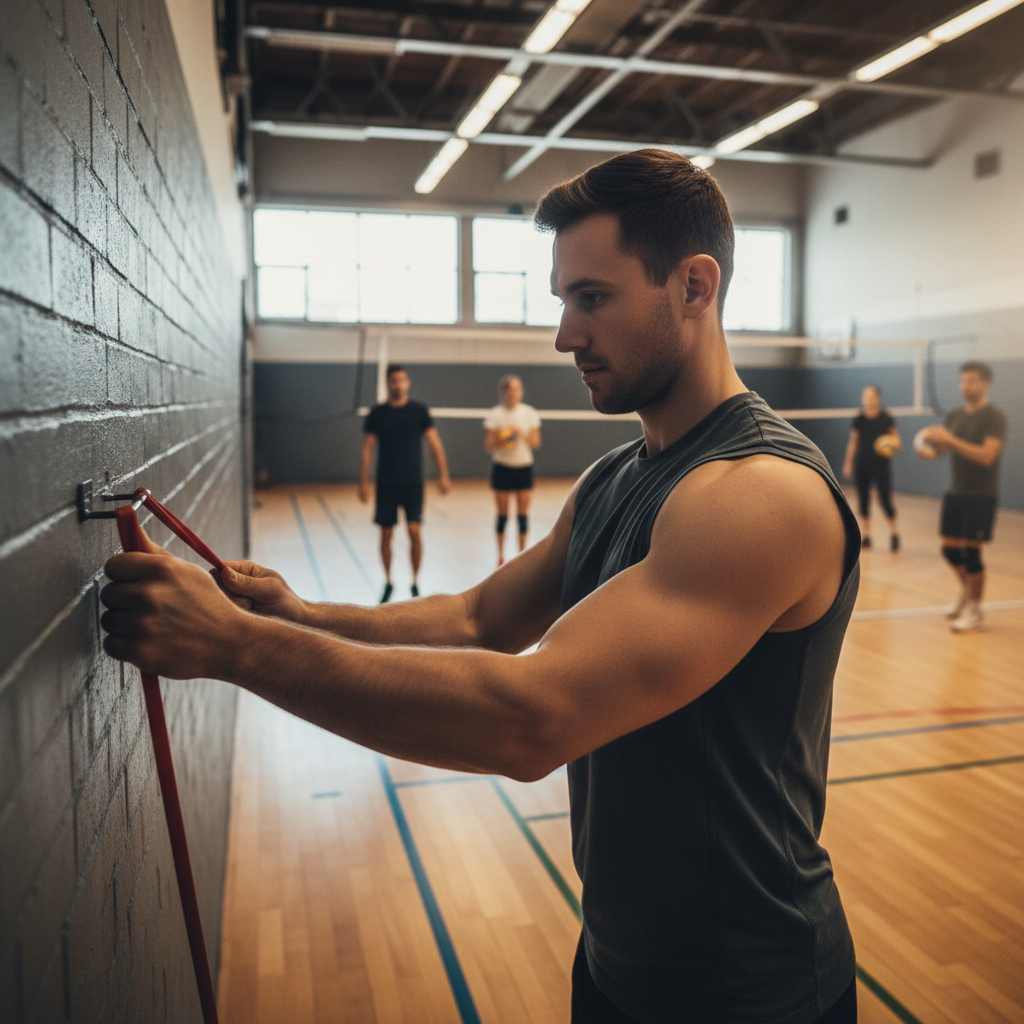
The overhead swing in competitive volleyball is one of the most violent repetitive motions in sports. A hitter might record over one hundred high-velocity swings in a single tournament day, placing immense strain on the posterior chain of the shoulder. Without a structured maintenance protocol, the imbalance between the powerful internal rotators and the stabilizing rotator cuff leads to inflammation, impingement, or labral tears. This twelve-minute routine is designed to bridge the gap between general stretching and high-intensity performance.
The Theory of Modern Shoulder Prehab
Effective prehab for hitters does not focus solely on the glenohumeral joint. Instead, it prioritizes scapular rhythm and thoracic mobility. For a hitter to generate power without damaging the connective tissue, the shoulder blade must move freely across the rib cage. If the thoracic spine is stiff, the humerus eventually overcompensates, leading to the common 'dropped elbow' that ruins mechanics and stresses the joint capsule. This routine targets these specific areas in three distinct phases: mobilization, activation, and dynamic integration.
Phase One: Thoracic and Capsule Mobilization
The first three minutes focus on opening the overhead range of motion. Static stretching is avoided here; instead, the goal is to lubricate the joint and increase blood flow to the surrounding fascia. This phase ensures that the later activation drills are occurring in a full, healthy range rather than a restricted one.
- Thoracic Extensions over a foam roller: 15 repetitions with hands behind the head to encourage extension without lower back arching.
- Quadruped T-Spine Rotations: 12 repetitions per side, following the hand with the eyes to maximize rotation through the mid-back.
- Sleeper Stretch Pumping: 10 repetitions per arm, holding the end range for only two seconds to gently signal the posterior capsule to relax.
Phase Two: Rotator Cuff Activation
From minutes four to eight, the focus shifts to the four muscles of the rotator cuff. Most hitters suffer from overactive pectoralis and latissimus muscles, which pull the shoulder forward into a rounded position. These exercises use light resistance bands—resistance should be low enough that the athlete does not feel a 'burn' in the large prime movers, but rather a deep engagement in the back of the shoulder.
External Rotation and Scapular Retraction
Standing with a light band held between both hands, keep the elbows tucked into the ribs. Pull the hands apart while keeping the forearms parallel to the floor. Perform two sets of 15 repetitions. This targets the infraspinatus and teres minor, which are crucial for decelerating the arm after a spike. If these muscles are weak, the arm remains under high tension long after the ball is struck, leading to chronic soreness.
Next, move to Banded Face Pulls with an emphasis on the 'W' finish. As the band is pulled toward the face, the athlete should rotate the palms to face forward. This integrates the rear deltoid and the lower trapezius. Complete two sets of 12 repetitions. Focusing on the pinch between the shoulder blades ensures the scapula is properly anchored for the upcoming practice session.
Phase Three: Dynamic Stability and Loading
The final four minutes prepare the nervous system for the speed of an actual hit. This is where the stabilized shoulder begins to move through the hitting arc. We transition from slow, controlled movements to reactive drills that mimic the chaotic environment of a volleyball rally.
- Wall Walks: Using a small loop band around the wrists, press out to create tension and walk the hands up and down the wall in a climbing motion for 45 seconds.
- Rhythmic Stabilizations: A partner gently taps the athlete's extended arm in different directions while the athlete maintains a locked position for 30 seconds per arm.
- Banded Pull-Aparts at 135 degrees: Perform 15 repetitions at an upward diagonal to mimic the high-reach point of an attack.
Implementing the Twelve-Minute Window
Consistency is the primary driver of success in injury prevention. This routine is most effective when performed immediately before the team's formal warm-up begins. Hitters should keep a light resistance band in their gear bag at all times. By dedicating exactly twelve minutes before every practice, a player accumulates over forty hours of active shoulder maintenance over a six-month season. This cumulative effect is what prevents the 'dead arm' syndrome commonly felt after mid-season tournaments.
Monitoring Progress and Fatigue
Athletes must distinguish between positive muscular engagement and negative joint pain. If a hitter feels a sharp pinch in the front of the shoulder during external rotation, they should reduce the resistance or range. The goal of this protocol is not to build massive strength, but to wake up the stabilizing structures so the larger muscles can do their job safely. A healthy shoulder is a quiet shoulder—one that allows the athlete to focus on the game rather than managing pain between points.
As the season progresses toward playoffs, peak volume usually increases. During these high-stress weeks, the prehab routine should never be skipped. In fact, increasing the focus on the eccentric (lowering) phase of the band work can help mitigate the high-impact load of extra games. By prioritizing scapular stability and thoracic health, hitters can maintain their peak reach and power from the first whistle of the season to the final point of the championship.
Related VolleyLab resources
Keep going with these hand-picked reads and programs from the VolleyLab library:
Turn this article into a training plan
VolleyLab builds a weekly program based on your position, level, and goals — no guesswork.
Start free trial