
Mastering Lateral Agility: Reactive Drills and Split-Step Timing
Enhance defensive range with effective split-step timing, reactive ladder drills, and change-of-direction strength specifically for volleyball defenders.
By VolleyLab Coaching Staff
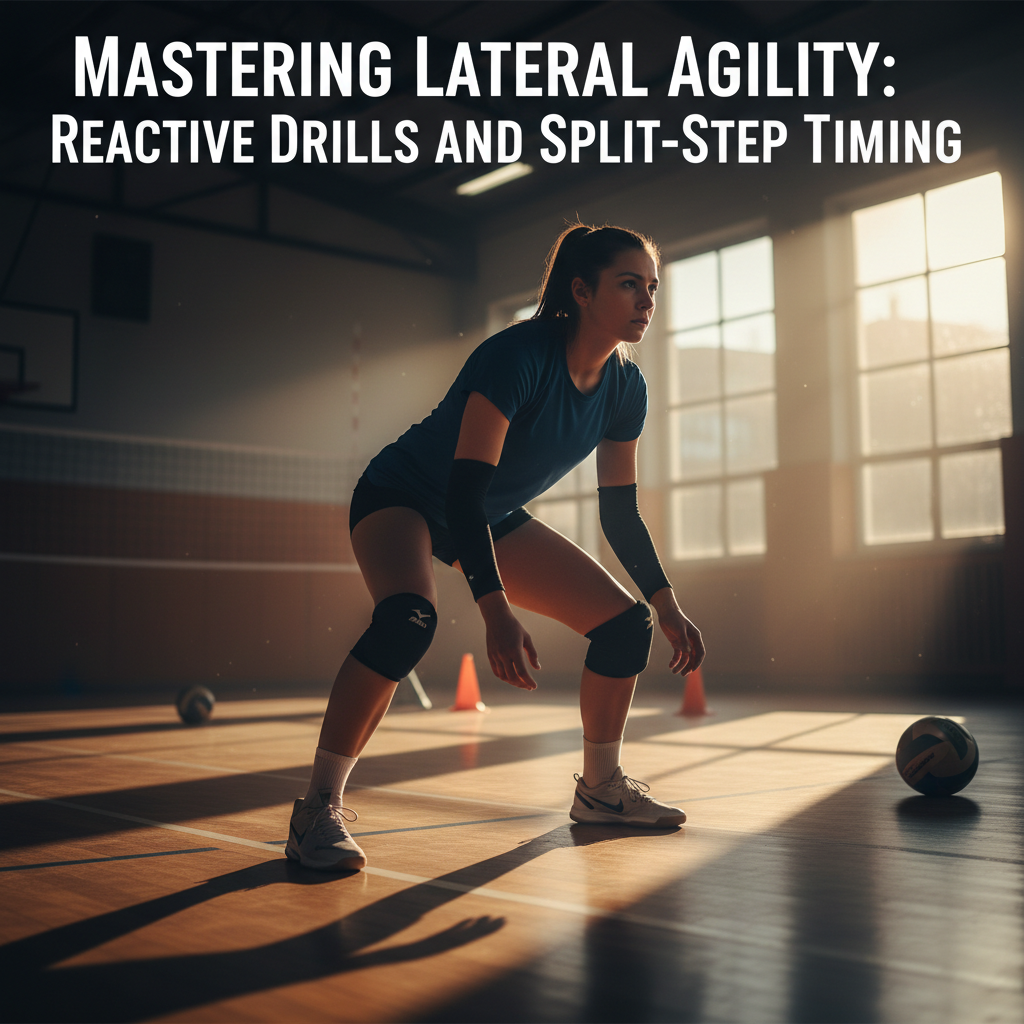
Defensive mastery in volleyball is often measured by the ability to cover the fifteen feet of court between the middle-back and the sideline in a fraction of a second. This mastery relies on three pillars: the neurological timing of the split-step, the mechanical efficiency of lateral movement, and the eccentric strength required to decelerate and redirect force. Without a focused approach to these areas, even the most athletic players will find themselves a step behind a well-placed attack.
The Mechanics of the Split-Step
The split-step is not a jump; it is a weight-neutralizing maneuver. It involves a slight hop that ends with the feet landing just as the attacker makes contact with the ball. The goal is to land with the center of gravity low and the weight on the balls of the feet. This creates a state of 'active tension' in the muscles, allowing for an immediate push in any direction. If a defender is static when the ball is hit, they must overcome significant inertia to move. The split-step uses the stretch-shortening cycle to bypass this inertia.
Timing is the critical variable. If the landing occurs too early, the advantage of the muscle tension is lost. If it occurs too late, the defender is caught in the air while the ball is already in flight. Observations of high-level defensive systems show that the peak of the hop should occur exactly as the hitter's hand reaches the apex of their swing. The feet should touch the floor roughly 0.1 to 0.15 seconds after contact, coinciding with the brain's initial recognition of the ball's trajectory.
Reactive Ladder Work for Neural Efficiency
Traditional agility ladders are frequently misused as cardiovascular tools rather than neuromuscular ones. To improve lateral agility, the ladder must move beyond pre-programmed patterns. Coaches should implement external stimuli to force the brain to choose a path during the movement. This bridges the gap between 'closed' agility—where the path is known—and 'open' agility, which mimics the unpredictable nature of a volleyball rally.
- Color-Coded Lateral Shuffles: Utilize colored cones at the side of the ladder. On a verbal cue, the player must exit the ladder at the nearest rung toward that color.
- Partner Mimicry: Two players face each other across the ladder. One leads a series of lateral steps, and the other must mirror them exactly without looking at their feet.
- Reactive Crossover Steps: A defender performs a rapid ikky-shuffle. On a whistle, they must immediately perform a crossover step and sprint to a ball held five meters away.
- Ball-Drop Transitions: The player works through the ladder while a coach holds a ball. When the coach drops the ball, the player must leave the ladder and touch it before it bounces a second time.
Developing Change-of-Direction Strength
Strength for defenders should focus on the lateral plane. Linear squats and deadlifts provide a foundation, but lateral movements require significant stability in the adductors, abductors, and gluteus medius. A defender's ability to 'brake' is more important than their ability to accelerate. If a player cannot stop their momentum quickly, they will overshoot the ball or fail to transition for a secondary contact.
The Eccentric Phase of Defense
To improve this, athletes must focus on eccentric loading. Lateral lunges with a slow, three-second descent help the connective tissue adapt to the high forces of a sudden stop. Once a baseline is established, adding a 'power' phase is necessary. This involves an explosive push-off from a deep lateral squat, ensuring the hips stay low and do not rise during the transition. Training this at 60-70 percent of a one-rep Max allows for high-velocity movements that translate directly to court performance.
Drill Progressions for Defensive Range
A structured practice plan should move from isolated mechanics to game-speed execution. These drills are designed to integrate the split-step and lateral speed into a single movement pattern. For maximum effectiveness, perform these early in a session when the central nervous system is fresh.
- Shadow Defense (2 sets of 10 reps): A coach stands on a platform mimicking a hitter's arm swing. The defender performs a split-step guided by the coach's movement, then explodes laterally to cover a target zone.
- The Triangle Recovery (4 sets of 45 seconds): Place three markers in a triangle. The player must shuffle, crossover, or backpedal between them, always returning to a low ready position between movements.
- Reactive Sled Drags (3 sets of 20 meters): Using light resistance, the player performs lateral shuffles. Resistance forces the player to apply more force into the floor, emphasizing the 'push' leg.
- Split-Step High-Velocity Digging (5 sets of 8 balls): A coach hits rapid-fire balls toward the corners. The player must reset their feet with a split-step after every touch, preventing 'lazy' stationary digging.
Measuring Success and Recovery
Lateral agility gains are measured in milliseconds. Using video analysis at 60 frames per second allows coaches to track the time between an attacker's contact and the defender's first meaningful step. A successful training block should see this reaction time drop consistently over 6 to 8 weeks. Because these drills are taxing on the nervous system, they should not be performed more than three times per week, with at least 48 hours of recovery between high-intensity sessions.
Conclusion
Elite defense is the result of deliberate practice applied to specific movement patterns. By combining the neurological benefits of reactive ladder drills with the physical foundation of lateral strength and the precisison of split-step timing, players can drastically increase their range. The goal is to make these high-speed adjustments unconscious, allowing the defender to focus entirely on the ball and the hitter's intentions. When the feet are disciplined, the platform becomes steady, and the defense becomes impenetrable.
Related VolleyLab resources
Keep going with these hand-picked reads and programs from the VolleyLab library:
Turn this article into a training plan
VolleyLab builds a weekly program based on your position, level, and goals — no guesswork.
Start free trial